CTR is one of the most important metrics used to measure the success of digital marketing campaigns. Digital marketing is essential in today’s online business landscape, contributing 6.5–8.5% of a company’s annual revenue, where even small performance changes can significantly impact sales, customer acquisition, and brand awareness. But how do you know whether your efforts are achieving the desired results? Each campaign has specific metrics that should be consistently monitored to optimize performance.
Table of Contents
Let’s look at Cost Per Click (CPC) as an example metric — it shows the cost of getting a user to click your ad. To reduce this in Google Ads, for example, you would typically adjust the keywords you are bidding on.
What Is CTR?
CTR stands for “ Click- Through Rate ” and is a crucial performance metric in digital marketing, advertising, and dispatch juggernauts. Its principally tells you the chance of people that see your announcement or open that action link, opened. In other words, It measures how well your content, announcement, or prompt encourages action from a stoner. The advanced click- through rate, the better as it generally means that your content is applicable, intriguing and targeted to the right followership.
CTR Meaning Understanding it in detail
It’s meaning all about measuring engagement. It is the rate between the number of clicks an announcement or link receives and the number of times it was presented( prints).
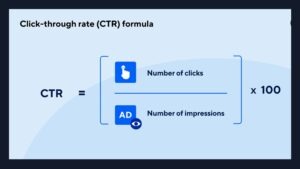
CTR formula
CTR() = (# of Clicks# of prints) X 100
For illustration, if your Google announcement was shown 1,000 times and entered 50 clicks, your result would be
50/ 1,000) X 100 = 5
While this is simply a chance, it tells a bigger story. It’s a direct index of how compelling and applicable your content is to the followership who sees it.
When a stoner sees your announcement or content, It shows how important of an impact your communication is making.
Why is CTR important?
There are several reasons to understand this metric, especially in search engine marketing (SEM), email campaigns, display advertising, and social media marketing. Here are a few key points:
It Measures Relevance
A rate above 5% indicates your message is resonating with your audience, meaning users find the title, description, or creative content compelling enough to take action. You can track performance using Google Search Console to identify pages that need optimization.
It Can Affect Quality Score (for Advertisements)
In paid advertising, this is a key factor in determining Quality Score, which influences ad placement and cost per click (CPC). Higher values generally lead to better quality scores, lower costs, and improved placement.
Increases ROI
Advanced CTR can lead to further business and eventually more transformations, and a advanced return on investment( ROI) for what you’re spending on marketing.
Enables crusade Optimization
Your generates data points every time your followership sees commodity. It’s a one- on- one literacy experience because you can use the perceptivity you gain to rework everything from captions, call- to- conduct( CTAs), keywords, and targeting.
How to calculate ctr
A calculator can be a useful tool for quickly determining this metric without performing the calculation manually. Simply enter the total number of impressions and clicks, and it will instantly provide the percentage result.
Example Use of a CTR Calculator
Let’s say you had
Prints 5,000
Clicks 200
Using the formula
CTR = ( 200/ 5,000) × 100 = 4
Many digital marketing platforms, such as Google Ads, Facebook Ads Manager, and email marketing providers like Mailchimp and Constant Contact, have built-in tools that automatically display this metric on their dashboards.
You can also easily calculate it using an online tool. Simply search for a calculator online, enter your impressions and clicks, and it will instantly display the result.
What’s a Good CTR?
There is not a widely accepted “ good ” CTR, as it can vary vastly grounded on the assiduity, platform, and type of crusade. still, a many average CTR marks include
Platform Average CTR
- Google Hunt Advertisements 3 – 5
- Google Display Advertisements 0.5 – 1
- Facebook Advertisements 0.9 – 1.6
- Dispatch juggernauts 2 – 5
- Organic Search CTR Depends on position first- position 28 still, you’re doing great, If you’re above normal on CTR for your assiduity or platform. If you’re below normal – it may be time to readdress your strategy.
This is determined by many factors. Knowing them can help you improve it! Here are some of the biggest ones: - Headline/ Title
Your caption is generally the first( and occasionally only) thing your druggies see. Keep your caption clear, terse, compelling, and action- acquainted. - Call to Action( CTA)
A strong call to action similar as “ Buy Now, ” “ Learn More, ” or “ Get Your Free Trial ” can produce a massive difference in clicks! - Targeting
The better you target your followership, the more interested they will be in your offer, and the advanced your CTR will be! - Ad Copy and Creative
In both visual and textbook advertisements, you need to have an announcement that really stands out from the crowd. An eye- catching visual combined with conclusive announcement dupe can make a world of difference! - Positioning
With hunt results – generally the advanced up on the runner, the advanced the CTR. Flash back, the number 1 result in Google gets roughly 28 percent of all clicks! - Keywords Applicability
The more applicable your keywords are to the druggies intent the advanced liability of clicks!
Strategies to Increase CTR
still, then are some practicable strategies to ameliorate it
If you are n’t happy with this.
- A/ B Test Captions – Test different captions to see which gets more clicks.
Use figures or Power Words – Titles like, “ Top 10 Tips ” or “ Secrets to ” generally reverberate better. - Include Clear CTA – Tell druggies exactly what to do. Prioritize Mobile – Make sure that your advertisements and emails are well formatted for smartphones.
- Upgrade Targeting – Reach the people that will watch about your offer.
- Use Rich particles for SEO – Using structured data will make your hunt results stand out.
CTR from Different Channels
Let’s take a moment to see how CTR translates in different popular digital channels
- Dispatch Marketing
With dispatch juggernauts, CTR means the chance of people who clicked on a link in your dispatch. CTR is different compared to open rates, which is the chance of people who opened the dispatch. A good dispatch CTR generally pars between 2 and 5.
- Search Engine Marketing.
With paid advertisements on Google Advertisements or Bing Advertisements, CTR is one of the important criteria for numerous reasons, including determining announcement rank and value/ effectiveness.
- Social Media Advertisements
Facebook, Instagram, Twitter, and LinkedIn all measure advertisements with CTR. Given the competition of social feeds, good CTR can drive costs down and ameliorate visibility.
- SEO and Organic Search
For organic website rankings, CTR shows how we’re performing with runner titles and meta- description values. Good CTR can potentially ameliorate your ranking over time as it shows applicability to Google.
Tools like Google Search Console help measure CTR, while Core Web Vitals and content marketing efforts contribute to better organic search performance.
Conclusions CTR as an Indicator of Engagement
In conclusion, this metric is more than just a number. It serves as an indicator of how well your digital content or advertising campaign is performing. Understanding its meaning, knowing how to calculate it, and learning how to interpret and improve the results can have a direct impact on your future online success.
Whether you’re managing a pay-per-click advertising campaign, running email marketing efforts, or trying to generate more website traffic through SEO, monitoring this performance indicator can help you optimize your strategy and improve engagement over time.
While major changes are not always necessary, small adjustments can often make a significant difference. Pay attention to your headlines, CTAs, targeting, and visuals, as even minor improvements in these areas can lead to better results.For more SEO best practices, refer to Google’s official SEO Starter Guide.